
PRESIDENCY NETHERLANDS
2024-2025

Use of RIS in navigation of the Rhine
Duty and responsibility to use RIS
Vessels navigating the Rhine are required to use the services specified in the Rhine Police Regulations. The CCNR and the waterway authorities additionally recommend using to the greatest extent possible the information provided by RIS and other services. The skipper retains responsibility for decisions related to navigation and to the heading of the vessel. Information provided by RIS is no substitute for the decision to be taken by the skipper.

Vessel equipment for using RIS
Vessels navigating on the Rhine are fitted with radiotelephone equipment that allows simultaneous two-channel reception of inland navigation radio (ship-to-ship and ship-to-shore). From 1 December 2014 onwards, vessels will be equipped with:
- an Inland AIS device,
- an Inland ECDIS device in information mode (or a comparable device for displaying charts) using up-to-date electronic inland navigation charts.
To make the best possible use of the services available, it is desirable that vessels should be fitted with:
- radar for displaying traffic in the immediate vicinity of the vessel,
- a PC with mobile data communication equipment (GSM) for e-mail and internet services as well as for electronic reporting,
- Inland ECDIS equipment in navigation mode (i.e. connected to the radar), in order to increase navigation safety.
Traffic centres (traffic posts)
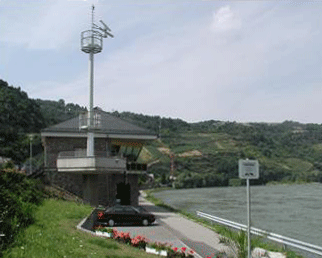
The waterway authorities have established traffic centres (traffic posts) along the Rhine. These are the major shore stations for radiotelephone communication in inland navigation as well as the centres for Inland Vessel Traffic Services.
Notices to Skippers
The waterway authorities offer for the Rhine and other waterways on dedicates websites notices to skippers in electronic form.
CCNR regulations pertaining to River Information Services and equipment
Neither the RIS Guidelines, the standards nor the Guide Concerning Radiotelephone Service on Inland Waterways are of themselves legally binding. For this reason, the CCNR has made additions to its legal regulations in order to introduce services, specify mandatory equipment and to require skippers to comply with standards. Article 1.03 of the Rhine Vessel Inspection Regulations stipulates that “Craft, floating establishments, or floating objects that require an inspection certificate to be issued shall comply with the requirements of these regulations and of the ES-TRIN”. The main requirements defined in the Rhine Police Regulations and in the Rhine Vessel Inspection Regulations are listed in the table below.
| Legal regulation | Content of the rule |
|---|---|
| Rhine Police Regulations | |
| Article 4.05 | Use of radiotelephone, basic requirements for radiotelephone equipment |
| Article 4.06 | Use of radar, basic requirements for radar equipment |
| Article 4.07(1) and (2) | Requirement to fit and use Inland AIS (from 1 December 2014 onwards) |
| Article 4.07(3) | Requirement to fit an Inland ECDIS device in navigation mode (or comparable device for displaying charts); requirement to use up-to-date electronic inland navigation charts (from 1 December 2014 onwards) |
| Article 12.01 | Reporting obligation (radio, electronic reporting) |
| European Standard laying down technical requirements for Inland Navigation vessels (ES-TRIN) | |
| Article 7.06(1) | Basic technical requirements for radar equipment |
| Article 7.06(2) | Basic technical requirements for Inland ECDIS equipment being operated in navigation mode |
| Article 7.06(3) | Basic technical requirements for Inland AIS equipment |
| Annex 5, Section I | Minimum requirements and test conditions for navigational radar installations in inland navigation |
| Annex 5, Section II | Minimum requirements and test conditions for rate-of-turn indicators in inland navigation |
| Annex 5, Section III | Requirements for installation and performance tests for navigational radar installations and rate-of-turn indicators in inland navigation |
| Annex 5, Section IV | Minimum requirements, requirements for installation and performance tests for Inland AIS equipment in inland navigation |
| Annex 5, Section VI | Installation and performance certificate for navigational radar installations, rate-ofturn indicators, for Inland AIS equipment and for tachographs in inland navigation |